S&P Global Ratings — RatingsDirect
October 20, 2026
Physical AI Promises A Step Change In Industrial Automation
AI can now pass the conversational Turing test. Physical AI — systems that sense, reason, and act within the physical world — takes on the harder question, promising more flexible, independent industrial automation as labor shortages, aging populations, and reshoring drive adoption.
Key Takeaways
- Physical AI, which describes artificial intelligence systems that sense, reason, and act within the physical world, promises improved flexibility and independence in industrial automation and, eventually, applications across many sectors.
- Adoption of physical AI will be iterative, involving deployment of different combinations of hardware (sensors, actuators, compute); software (perception, language, vision-language-action models); and algorithms (policies, spatial mapping, physics simulation), and will improve with innovation, such as developments in short-path problem solving.
- Structural economic issues, including aging populations, labor shortages, and reshoring, will be key drivers of physical AI adoption, although expectations of its potential benefits vary widely, as is typical with early-stage technologies.
Advances in AI have made machines remarkably adept at imitating human behavior in the digital world. In a University of California San Diego study of large language models (LLMs), OpenAI's GPT-4.5 was judged by humans to be human 74% of the time in a three-party Turing Test, while Meta's LLaMa-3.1-405B achieved 56% (see "Large language models pass a standard three-party Turing test," Proceedings of the National Academy of Sciences, May 19, 2026). The test, conceived by Alan Turing in 1950, assesses machine behavior based on conversation, but it leaves a much tougher question unanswered: can AI interact with the physical world like a human?
That is the idea behind the Physical Turing Test, a framework introduced by chipmaker NVIDIA's director of Robotics Jim Fan. Rather than asking if a machine can mimic human conversation, it tests if a machine can perform a complex physical task — tidying a room and preparing dinner — in an unpredictable real world setting so effectively that the result is indistinguishable from human activity.
Physical AI, which pairs generative AI's reasoning capabilities with sensors, actuators, and robotics, is the field of study and development that is seeking to make that goal a reality. It promises a future in which machines, including robots and vehicles, act with increasing autonomy, independence and safety, often alongside humans.
While application, typically in manufacturing and logistics settings, is already underway, passing the Physical Turing Test remains a likely distant achievement. Moreover, progress has become somewhat bifurcated: the U.S. leads in software and AI integration (thanks to champions like NVIDIA, OpenAI, and Figure AI); China has advantages in robotic capacity, deployment, and cost efficiency (through Unitree, UBTECH, and AGIBot). Yet S&P Global Ratings considers advancements in physical AI, and the speed of progress, already suggests significant possibilities for unsupervised, or marginally supervised, automation, with implications for capital spending, operational efficiencies, and outputs across a wide range of activities and sectors.
Beyond Advanced Automation And Mobile Generative AI
Traditional industrial robots excel at performing precise and repetitive tasks, typically at speed with little marginal cost. Physical AI promises a fundamental overhaul of that functionality by extending robots' applicability (and benefits) to activities that require dexterity and involve variation and unpredictability. This both expands the potential scope of automation and raises the technological and operational parameters for success.
It also pushes the minimum standard of success for AI. That is not least because acting intelligently is considerably more difficult than sounding intelligent. Ask a large language model to write a poem, and the hardest part of its job is choosing the right words. Ask a warehouse robot to pick an anthology of poems off a shelf, and it might have to recognize a book among other objects, judge how and where to grip it, avoid people and machinery moving nearby, and quickly make those judgements in a changing world. Additionally, where a chatbot can regenerate an erroneous answer (or be ignored) physical errors could result in damage, outages, and safety risks.
Physical AI sits at the center of the complexity, risk, and potential of both automation and generative AI as it is designed to perceive, reason about, and act within the physical world through machinery — loosely speaking it connects the intelligence to the body. The result, notably due to advances in AI-enabled perception, learning, and decision making, should be machines that increasingly respond to variability rather than simply follow predefined instructions.
Physical AI's Three Layers: Hardware, Software, And Algorithms
Physical AI is not a single, new technology. Rather it is the integration of three distinct elements, or technological layers, that work together in real time to deliver new capabilities (see table 1).
| Layer | Components | Human equivalent |
|---|---|---|
| Hardware | Robotics and machinery that enable physical movement; sensors that interact with the environment | The body and nervous system |
| Software | AI models that interpret sensor data, understand language and context, and reason to instruct actions | The brain, including the visual and motor cortexes and language centers |
| Algorithms | Transform reasoning into safe sequences of physical actions; informed by rehearsal in simulations | Learned skills and muscle memory that are refined through practice |
The efficacy and speed at which the hardware, software, and algorithms are integrated into effective and safe systems will determine the extent and pace of physical AI's deployment, its reshaping of automation from specialized application to autonomy, and its economic implications for entities, industries, and nations.
Hardware: Giving the machine a body
To make meaningful decisions, machines must perceive their environment. This is the role of physical AI's hardware layer, which generally comprises four categories: sensing, actuation, compute and connectivity, and power (see table 2).
Sensing hardware broadly acts as a machine's nervous system. This includes cameras (both standard and depth-sensing), lidar, radar, inertial measurement units (gyroscopes and accelerometers to track orientation and motion), force and torque sensors, tactile "skin", and Internet of Things (IoT) instrumentation and telematics (that report temperature, vibration, location, and equipment status). For example, a delivery robot might use cameras and lidar to "see" and for depth perception and a gyroscope for balance.
Actuation hardware serves as a machine's motor nerves and muscles, enabling it to act on data from its sensing hardware. Components include servo motors, hydraulic and pneumatic actuators, robotic grippers and end effectors (dexterous multi-fingered hands in humanoid designs). While sensors carry signals inward, actuators carry commands outward.
Compute and connectivity hardware, including edge AI processors, general-purpose and graphics processing units (CPUs and GPUs), and wireless or 5G connectivity, function like a nervous system's relay stations. This hardware determines whether a machine requires an instant local reflex (pulling away from something hot) or slower, deliberate processing.
Power systems act as the machines metabolism. They decide the limits of operational duration and payload capacity much like energy limits endurance in humans.
| Category | Function | Examples |
|---|---|---|
| Sensing | Perceives the environment | Cameras, depth sensors, lidar, radar, gyroscopes/inertial measurement units, force and torque sensors, tactile sensors, IoT telematics |
| Actuation | Physically acts on the environment | Servo motors, hydraulic and pneumatic actuators, grippers, robotic hands, wheels and legs |
| Compute & connectivity | Processes data and coordinates action, locally and remotely | Edge AI chips, onboard GPUs/CPUs, microcontrollers, 5G/Wi-Fi links |
| Power | Supplies and manages energy | Lithium-ion battery packs, power electronics, energy management systems |
Software: The machine's mind
If hardware provides a machine's body, software provides the mind to interpret sensory data. Physical AI's software stack is generally organized into layers that build on one another (see table 3).
Perception models, typically computer vision systems, form a base, converting raw camera, lidar, and radar data into environmental understanding. Vision-language models (VLMs) build on this by pairing that visual data with natural language, connecting sight to written or spoken instructions. Large language models (LLMs) contribute broader reasoning and planning, allowing a system to break complex instructions, such as "clear the table", into sequential sub-tasks.
Vision-language-action models (VLAs), which combine perception, language understanding, and motor control in a single system, are the newest and most consequential addition to the physical AI software stack. Unlike earlier robots that relied on manually-coded rules for each task, VLAs are trained on large datasets of demonstrations to translate images and instructions directly into motor commands — in effect, learning "this is what a good grasp looks like" in a similar way that LLMs learn "this is what a good sentence looks like." Since 2024, several VLA systems have moved transitioned from research to deployment, including Google DeepMind's RT-2, Figure AI's Helix, NVIDIA's Isaac GR00T, and Physical Intelligence's π (pi) models. Each employs varying architecture to balance broad reasoning with the rapid reaction times required for physical action.
Middleware, such as the widely used, open-source Robot Operating System (ROS), serves as the underlying framework that coordinates sensor data, models, and actuator commands, similar to a laptop's operating system. We consider mastering VLA-hardware integration will create a significant strategic moat that will distinguish advanced physical AI providers from those using traditional, decoupled architectures.
| Layer | Description | Examples |
|---|---|---|
| Perception models | Interpret raw sensor data into an understanding of objects, people, and surfaces | Computer vision and object-detection models |
| Vision-language models | Connect visual understanding with natural-language instructions | General-purpose multimodal models adapted for robotics |
| Large language models | Provide broader reasoning, planning, and task decomposition | Foundation models used for high-level task planning |
| Vision-language-action models | Fuse perception, language, and motor control into direct action commands | Google DeepMind RT-2, Figure AI Helix, NVIDIA Isaac GR00T, Physical Intelligence π |
| Middleware | Coordinates communication between sensors, models, and actuators | Robot Operating System (ROS), vendor-specific control stacks |
New Technologies Are Delivering New Capabilities
While much discussion about physical AI focuses on the "brain", AI also requires efficient pathways to move massive amounts of data between sensors, processors, and actuators — just as the human body relies on a nervous system to transmit information between the brain, senses, and muscles. This connectivity is vital to physical AI's real-time interaction with its environment.
Silicon photonics, also known as photonic chips and fiber-optic chips, address this need. These chips bring the ultra-low-loss performance of optical fiber directly onto semiconductors, using light instead of electrical signals to move data. This can dramatically increase bandwidth while reducing power consumption, making it a critical enabler for next-generation AI infrastructure where data transfer speed is as important as processing in enabling machines to react quickly and scale to real-world complexity.
Sensory capabilities are also advancing with the application of biologic elements. In 2024, researchers in Tokyo developed human-like skin tissue for robots by layering human skin cells onto a resin base. This skin can self-repair using collagen-based integration, similar to wounded human skin, and makes integrating sensory functions, like touch and temperature detection, more feasible with this living tissue. This marks a significant step toward creating more lifelike, responsive, and socially acceptable humanoid machines that could be particularly useful in close proximity to humans, such as in the health care sector and for companion services.
While these advances bring us closer to truly human-like machines, many successful robotic platforms — such vacuum cleaners and wired industrial arms — will continue to be built for efficiency rather than appearance. However, humanoid robots may have a developmental advantage, as noted by NVIDA CEO Jensen Huang during his GTC 2026 Keynote address when he said "…we have a lot more imitation training data that we can provide (humanoid) robots," (see "NVIDIA GTC 2026 Keynote," March 2026).
Algorithms: The decision system
In physical AI it is algorithms that determine the situation specific, safe actions that bridge the gap between software perception and hardware physical action. Three concepts are central here: policies, spatial mapping, and physics simulation (see table 4).
Policies, in this context, are the learned rules that map situations to actions — for example, if the cup is here and the gripper is there, close the fingers this much and this fast. Developers typically create policies with reinforcement learning (whereby a system improves by trial and error) and imitation learning (the mimicking of many human examples, often via teleoperation). Most modern robotic systems use both approaches.
Spatial mapping techniques, most notably simultaneous localization and mapping (SLAM), allow a machine to build and continuously update an internal map of its surroundings while tracking its own position. This is similar to how a person navigates a familiar building using a mental map and their sense of location.
Physics simulation and emulation, often organized as "digital twins" of a robot and its environment, allows developers to train and test a policy millions of times in a virtual world. Much like a flight simulator allows a pilot to practice under emergency conditions without risking an aircraft, these simulations let robots practice dropping objects, colliding, and losing their footing without safety consequences. Platforms such as NVIDIA's Isaac Sim and the open-source MuJoCo engine are widely used for this purpose. Such simulations can be imperfect, creating a "sim-to-real gap" where a policy performed flawlessly in simulation fails in the real world, often because simulated physics, lighting, and materials do not perfectly match reality. Researches are working to close this gap with more realistic simulations and through hybrid training that combines simulated and real-world data.
| Component | Description | Examples/techniques |
|---|---|---|
| Policies | Learned mapping from a perceived situation to a physical action | Reinforcement learning, imitation learning, teleoperation-based training |
| Spatial data and mapping | Builds and updates an internal map while tracking the machine's position within it | Simultaneous localization and mapping (SLAM), occupancy grids |
| Physics emulation and simulation | Virtual rehearsal environment used to train and test policies before real-world deployment | Digital twins, NVIDIA's Isaac Sim, MuJoCo, sim-to-real transfer techniques |
In the future, robots may use embedded models and choose the most effective neural path to process information, similar to human cognition. For example, a robot might prioritize shorter paths for routine tasks, unlike current AI systems which typically expend the same amount of computational effort on simple and complex problems. For example, a robotic arm operating in a known environment might use a shorter, learned pattern to reach an object, but switch to a more complex calculations when facing an unfamiliar or complicated situation. This flexibility, which will rely on causal AI and embedded learning, may also prove key to scaling in industrial settings (see "Causal AI: How Cause and Effect Will Change Artificial Intelligence," May 27, 2025, and "Brain-Inspired AI Agents: How New Research Validates XMPro's Cognitive Approach to Industrial AI," Pieter van Schalkwyk, April 6, 2025).
The Sense-Plan-Act Loop
Autonomous robotics essentially operate by reducing to a single loop (that can be repeated many times a second) a process involving sense, interpret, plan, act, and check. For example, a mobile warehouse robot might continuously gather camera and lidar data (sense); uses perception models and SLAM systems to understand its surrounding and location (interpret); apply a policy informed by a higher-level target (such as "retrieve item from aisle 12"); decide its next move (plan); sends commands to its motors (act); and immediately re-senses its environment to confirm success and adjusting if it did not.
The loop's speed is as important as its logic. High-level reasoning, such as understanding a spoken instructions or planning multi-step tasks, can tolerate short delays — much as a person might pause to think before starting a task. However, low-level motor control, such as a robotic hand adjusting its grip on a slipping object, must react in a fraction of a second. This is why many of today's most capable systems, including Figure AI's Helix and NVIDIA's GR00T models, use two-speed (dual-system) architecture: a larger, slower model for reasoning and task understanding, and a smaller, faster model running locally on the machine itself manages the split-second business of moving. This division of labor mirrors the relationship between conscious thought and automatic reflexes.
Autonomy also exists on a spectrum rather than as a binary state. It ranges from robots executing fixed, pre-programmed sequences to systems that adapt within a narrow, well-defined task, to general-purpose systems that can flexibly handle novel objects, layouts, and instructions with little or no task-specific reprogramming. Most industrial physical AI currently sits toward the middle of that range; while full general-purpose autonomy remains the domain of frontier research and popular science fiction.
Demographics Support Physical AI And Autonomous Robotics Adoption
Demographics and efficiency drive the industrial case for physical AI. Manufacturing and logistics employers in major economies face persistent labor shortages. In the U.S., industry surveys show hundreds of thousands of unfilled manufacturing positions despite a prolonged contraction in new orders, signaling a skills and demographics gap rather than a lack of work. Aging populations in key manufacturing economies, including Japan, South Korea, and China, will shrink labor markets. In Japan and South Korea, industrial workforce participation has declined 3% to 5% over the past two decades due to aging and industrial specialization, resulting in labor shortages. Simultaneously, tariffs, shipping costs, and geopolitical risk are pushing companies to reshore or near-shore production. To remain competitive these reshored facilities must match the labor costs of overseas operations, a gap that automation, rather than wages, is increasingly expected to close.
The scale of existing industrial automation illustrates both the momentum and the potential of the technology. A record 542,000 industrial robots were installed worldwide in 2024, more than double the number installed a decade earlier, according to the International Federation of Robotics (see "World Robotics 2025," International Federation of Robotics (IFR), Sept. 25, 2025). This increased the operational stock of industrial robots to about 4.7 million units. Preliminary 2025 data points to a further acceleration, with global installations rising sharply and the U.S. market rebounding after two years of decline. Yet automation is far from ubiquitous: the IFR report puts the share of U.S. factories operating without robotics or automation at about 80%. This underscores the potential for continued growth in established industrial robotics, as well as physical AI like humanoid and mobile robotics.
Market research on physical AI — distinct from the broader industrial robotics — reveals both significant opportunity and data immaturity. Estimates of the physical AI market's size and growth potential vary widely because research firms use different scopes, such as counting AI software layered onto existing robots or only the full hardware-plus-software stack. Uncertainty inherent to the forecasting of an emerging category is also a factor. Yet most forecasts agree growth will be steep, with compound annual growth rates of 30% to 45% over the next five to 10 years (see table 5). There is also broad agreement that manufacturing, logistics, and automotive applications will lead early adoption, with the Asia-Pacific region, driven by China, Japan, and South Korea, likely to be the fastest-growing region.
| Source | Base year value (2025) | Forecast (year) | Implied CAGR |
|---|---|---|---|
| Grand View Research | $81.6 billion | $960.4 billion (2033) | ~36% |
| Mordor Intelligence | $5.1 billion | $34.9 billion (2031) | ~37% |
| MarketsandMarkets | $0.9 billion | $15.2 billion (2032) | ~47% |
| Astute Analytica | $3.5 billion | $58.1 billion (2035) | ~32% |
| Precedence-type/Cervicorn | $5.0 billion | $82.8 billion (2035) | ~33% |
| SNS Insider | $5.2 billion | n/a (2035 CAGR only) | ~33% |
Beyond demographics, industrial physical AI adoption will also be driven by specific workplace benefits. Machines can operate in conditions unsafe or undesirable for people, such as extreme heat and confined spaces, and perform tasks that induce repetitive strain injuries. They can also operate nearly continuously, limited only by maintenance and charging requirements, rather than across fixed shifts. Furthermore, because VLA models can learn tasks by demonstration, avoiding the need for custom-written control software for each product variant, physical AI reduces the engineering cost of automation. This is particularly pertinent for small- and mid-sized manufacturers that previously could not justify the cost of bespoke robotics.
Physical AI Discussions Are Transitioning From Feasibility To Adoption
The current multi-year deployment window represents a critical inflection point, with physical AI transitioning from experimental research prototypes to production-grade, commercially viable deployment. Market signals indicate that participants are shifting their focus from technical feasibility to the speed of scaling. Companies, especially in the industrial, information technology and utilities segments, are discussing physical AI more frequently with investors. Analysis of earnings call transcripts over the past two years indicates a sharp increase in these discussions, particularly in those sectors (see chart 1 and chart 2).
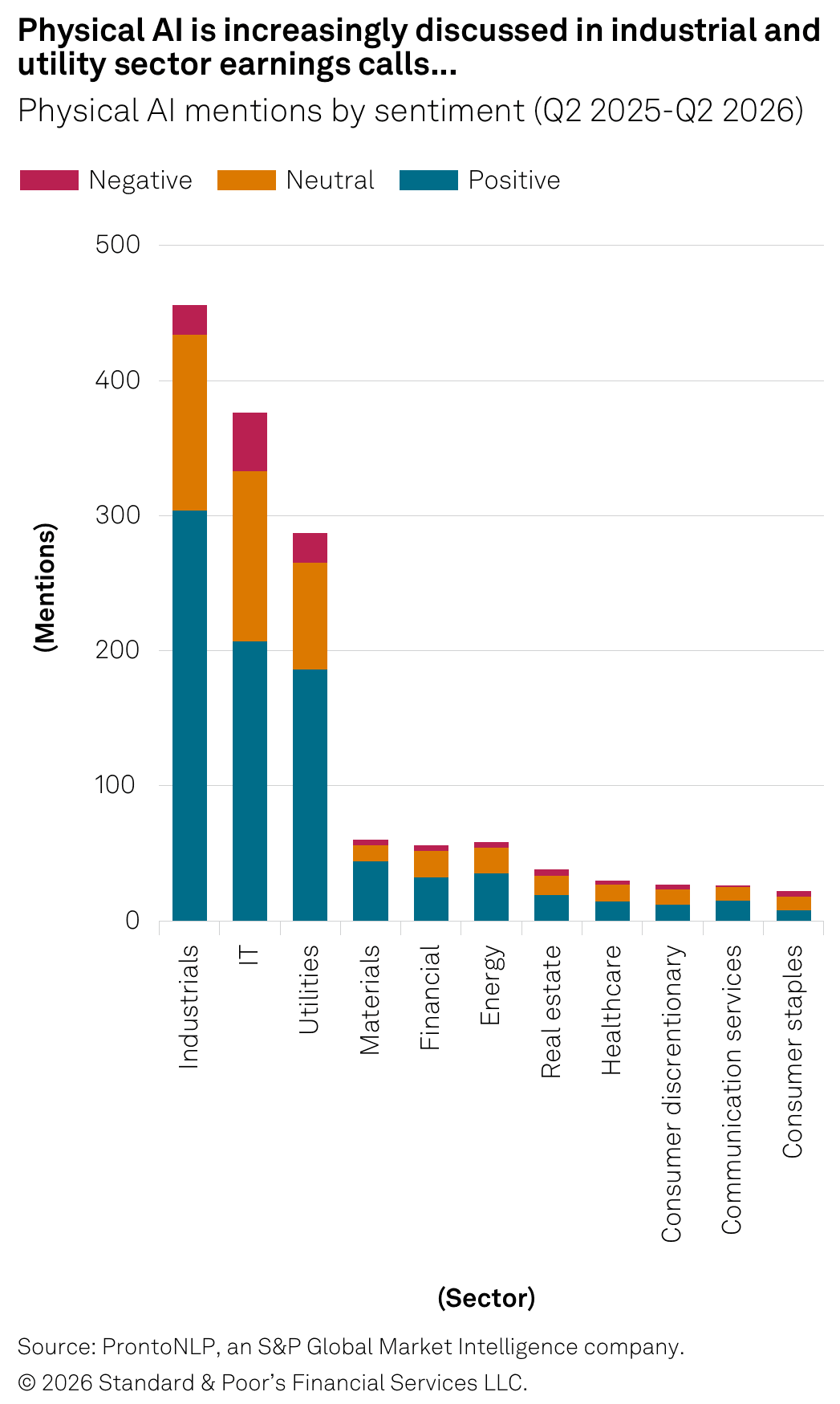
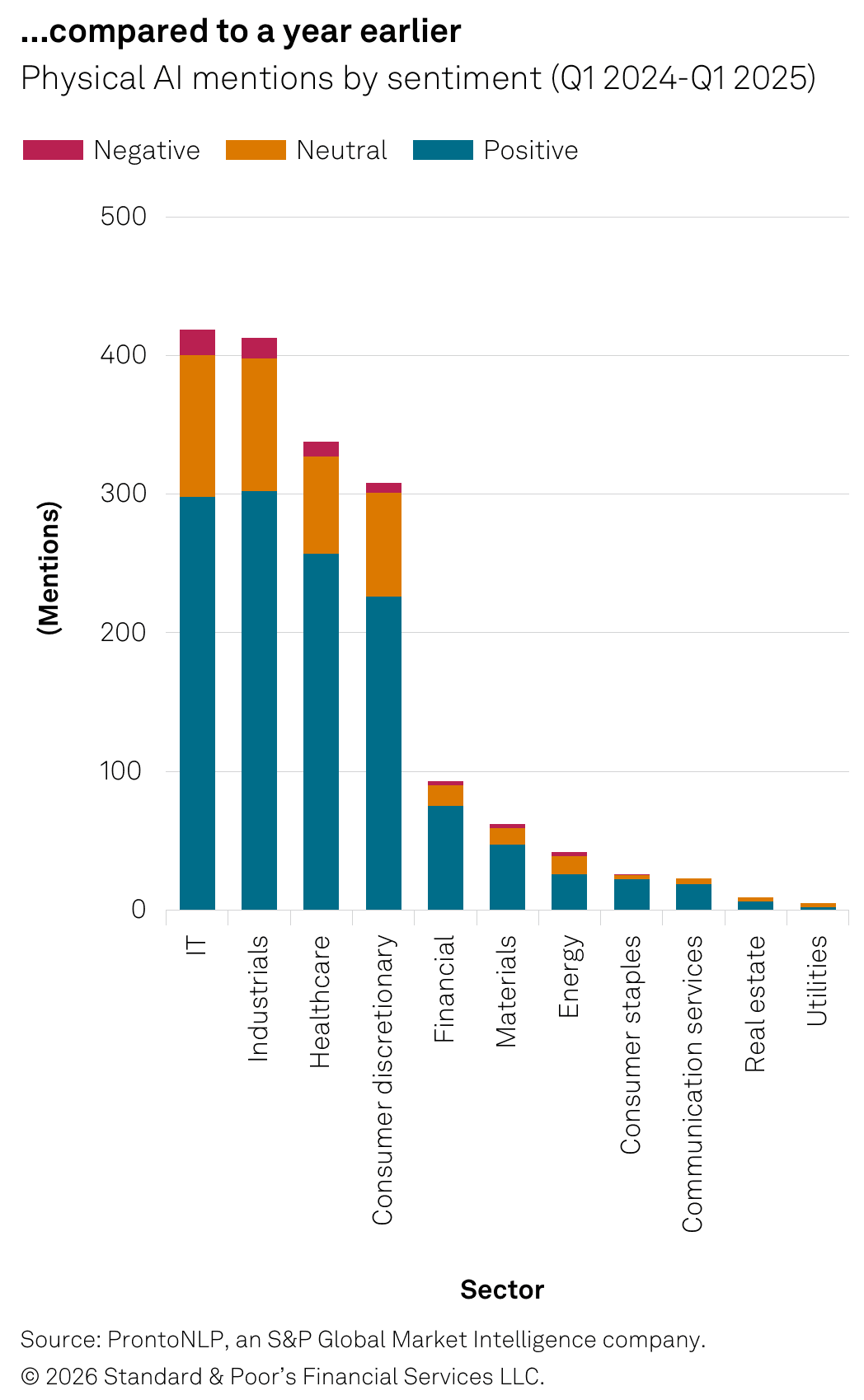
The analysis of earnings call suggests that sectoral interest in physical AI has shifted significantly over the past year. While information technology dominated discussions in 2024, industrials lead in total volume over 2025-2026, though IT continues to benefit from AI-driven tailwinds, boasting the highest positive sentiment ratio at about 53.6%. At the other end, the materials sector's struggles with tariff and commodity headwinds are likely to have driven its negative sentiment ratio of about 10.5% in the 2025-2026 data. Despite these variations, the broader trend appears optimistic, with positive sentiment averaging over 50% across sectors, according to the 2025-2026 data.
Physical AI In Practice: From Cleaning To Augmentation, Via Taxi Rides
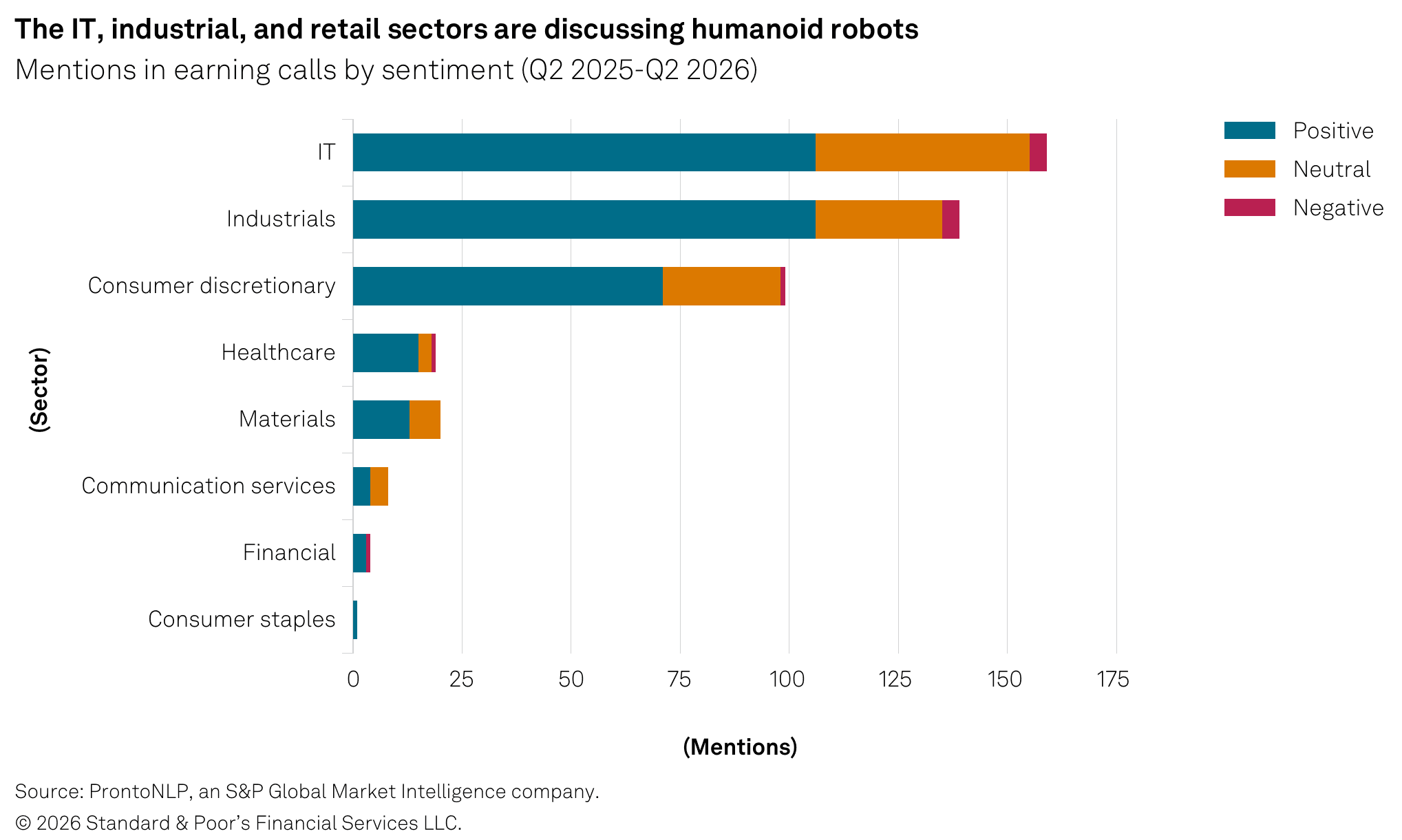
Physical AI in the form of autonomous robots, including humanoid models, is transitioning from experimental prototypes to functional deployment and garnering increased attention in several sectors (see chart 3). Humanoid, and semi-humanoid, robots are commercially available for use in elderly care and assistance (Neo Gamma from 1X) and customer service, predominantly in retail settings (Sophia of Hanson Robotics' Sophia, and Pepper developed by SoftBank Robotics and Aldebaran). Manufacturing and automotive sectors are among the leaders in integrating autonomous robotics into production, with Boston Dynamics' Atlas designed for high-risk industrial tasks, Tesla's Optimus currently operating in its Fremont factory, and Figure AI's Figure 03 units completing operational testing at BMW's Spartanburg plant. In education and research, programmable robots are used to teach robotics and STEM disciplines (SoftBank Robotics and Aldebaran's NAO).
Autonomous vehicles represent the most significant large-scale deployment of physical AI, including VLA models to navigate unstructured environments. Tesla's Full Self-Driving (FSD) technology has demonstrated its safety capabilities, managing vehicle stops during driver medical emergencies. Commercial scalability is being proven by Waymo, which has completed millions of autonomous rides in U.S. cities, and by Amazon-owned Zoox, which provides steering-wheel-free robotaxis in Las Vegas and San Francisco. Chinese firms including Baidu Apollo, Pony.ai, and WeRide operate commercial robotaxi services in multiple Chinese cities, encouraged by regulation that increasingly permits driverless operation.
At the cutting edge of physical AI, the recent MIT Hard Mode 2026 hackathon was won by "Human Operator," a wearable AI system that used Anthropic's Claude for voice commands, Vision Language Models (VLMs), and Electrical Muscle Stimulation (EMS) to translate voice commands into physical muscle movements. This suggests a future where physical AI moves beyond assistance or third party services to support motor learning, skill acquisition, and human augmentation.
The physical AI market is at a turning point as the technology transitions from research and development toward early commercialization and rapid growth. Specialized component suppliers will likely emerge as near-term winners, eventually giving way to full-stack integrators and data-monetization specialists. This growth is unfolding within a distinct two-tier global dynamic: China dominates hardware and manufacturing, while the U.S. leads in software and AI differentiation. Yet, the industry faces obstacles, including complex regulatory standards, reliability challenges, and potential supply chain constraints in the rare earth and battery sectors.
Physical AI Risks Include And Extend Beyond Those Of Traditional AI
Physical AI shares many of the technical risks common to AI generally, such as biased training data and the difficulty of explaining model decisions. However, it also carries risks specific to kinetic action, as errors can cause physical harm rather than simply a wrong answer on a screen. These additional risks and challenges include:
Safety and the sim-to-real gap: Policies trained in simulation may behave unpredictably when real-world friction, lighting, or object properties differ from the simulated environment. Consequently, extensive real-world testing, safety certification, and human oversight will remain standard practices, even for capable systems.
The embodiment gap: Physical AI systems often outperform humans on narrow, well-defined tasks, but struggle with the general-purpose dexterity and judgment humans use instinctively, such as when handling unfamiliar objects. Closing this gap remains an active research priority rather than a solved problem.
Cybersecurity: Physical AI systems are, by design, connected to sensors, to networks, and often to the cloud. This expands the attack surface of factories or fleets beyond that of traditional, disconnected machinery. Additionally, AI agents have demonstrated an ability to systematically "escape" containers where guardrails aren't clear or rigid. The potential for AI systems to act in the physical world significantly increases the potential for harm and the need for robust security.
Capital intensity and integration cost: Unit costs for robots and components are falling, yet deploying physical AI at scale still requires meaningful upfront investment in hardware, integration, and workforce retraining. This cost, which is also in time, may slow adoption relative to purely digital AI tools.
Workforce transition: While the net long-run effect of physical AI on employment is uncertain (as it was with earlier waves of automation), the near-term effect will include a shift in the mix of skills needed on a factory floor. Roles will move from manual, repetitive tasks toward oversight, maintenance, and exception-handling.
Interoperability: Integrating physical AI with existing physical and digital infrastructure will be challenging. Many industrial environments are not designed for autonomous AI systems, creating risks around communication protocols, enterprise software, and real-time coordination.
Technological Convergence And Demand Will Drive Physical AI
Physical AI is best understood not as a single technological leap but as the gradual convergence of three elements that had, until recently, advanced mostly on separate tracks: robotic hardware, foundation-model software borrowed from the broader AI boom, and algorithms and simulation tools that facilitate safe training and testing. The wide range of expectations surrounding physical AI's potential uses, the size of the market, and the pace of development suggests this convergence is in its early stages, with no consensus view yet emerging.
The drivers of underlying demand for the technology are clearer. Structural labor shortages, aging workforces, and reshoring pressures provide manufacturers and logistics operators with concrete, near-term reasons to invest in automation. This impetus will continue, regardless of when more advanced, general-purpose physical AI technologies, such as minimally supervised humanoid robots, arrive.
Related Research
- Causal AI: How Cause and Effect Will Change Artificial Intelligence, May 27, 2025
- Machine Learning: The Fundamentals, Nov. 29, 2023
- Foundation Models Powering Generative AI: The Fundamentals, Nov. 29, 2023
External Research
- Large language models pass a standard three-party Turing test, Proceedings of the National Academy of Sciences, May 19, 2026
- World Robotics 2025-Industrial Robot, International Federation of Robotics, Sept. 25, 2025
- Brain-Inspired AI Agents: How New Research Validates XMPro's Cognitive Approach To Industrial AI, Pieter van Schalkwyk, April 6, 2025
- Advances And Challenges In Foundation Agents: From Brain-Inspired Intelligence to Evolutionary, Collaborative, and Safe Systems, Liu, B., et al., March 31, 2025
- Isaac GR00T N1: An Open Foundation Model for Generalist Humanoid Robots, NVIDIA, March 18, 2025
- Helix: A Vision-Language-Action Model for Generalist Humanoid Control, Figure AI, Feb. 25, 2025
- π₀: A Vision-Language-Action Flow Model for General Robot Control, Physical Intelligence, Black, K., et al., Oct. 31, 2024
- RT-2: Vision-Language-Action Models Transfer Web Knowledge to Robotic Control, Brohan, A., et al., Google DeepMind, July 28, 2023
The views expressed are those of the authors and do not necessarily reflect the opinions of S&P Global.