S&P Global Ratings — RatingsDirect
May 26, 2026
Hype Or Not, Mythos Signposts AI's Growing Importance In Cybersecurity
Anthropic's Mythos model reignited a debate about AI and offensive cyber capability. Whether or not it marks a genuine inflection point, it signals a threat already in motion — and a growing, measurable factor in credit quality.
Key Takeaways
- Anthropic's claim that its Mythos model heralds a step-change in AI-driven cyber risk has focused attention on a threat already in motion: AI's growing ability to discover and exploit cybersecurity vulnerabilities at scale.
- Whether Mythos represents a genuine inflection point or an incremental evolution, AI is already altering the speed and probability of cyberattacks and prompting a necessary reassessment of the stage-gate assumptions that underpin threat management in many organizations.
- Much of Mythos's capability may reside in its operational framework — the "harness layer" — rather than the model itself. This suggests replication barriers are lower than headlines imply and that sophisticated threat actors may already have access to comparable offensive tools.
- AI is both a threat amplifier and a defensive instrument. An organization's ability to exploit defensive AI while managing exposure to AI's threats depends on governance quality, leadership decision-making, and investment prioritization — all of which are observable and credit-relevant variables.
Anthropic's unveiling of its latest large language model, Claude Mythos Preview, was accompanied by the announcement of Project Glasswing, a restricted deployment of the model to 12 technology and finance partners — including Amazon Web Services, Apple, Cisco, CrowdStrike, Google, JPMorgan Chase, Microsoft, NVIDIA, and Palo Alto Networks — and over 40 critical-infrastructure organizations.
This is the first time Anthropic has declined to release a model to the general public, citing offensive capabilities deemed too dangerous for broad distribution. A public disclosure report is expected in July 2026.
Anthropic's claims are substantial. Mythos reportedly identified thousands of high-severity zero-day vulnerabilities across major operating systems and browsers within weeks, achieved autonomous tier-5 (Anthropic's highest level) exploit chaining on fully patched systems without human guidance, and surfaced legacy vulnerabilities — some decades old — that automated scanning tools had failed to detect after millions of passes. The UK AI Safety Institute independently verified that Mythos solved 73% of expert-level capture-the-flag challenges. No prior model had solved any. The institutional response was rapid: U.S. Treasury Secretary Scott Bessent convened Wall Street CEOs to discuss Mythos's risk within days of the announcement.
Yet the announcement has also invited scrutiny. Initial reports from Glasswing participants suggest that much of Mythos's efficacy stems not from the model but from its "harness layer" — the operational framework that injects context and history into prompts, manages tool calls, converts inputs into usable tokens, and filters outputs. In AI deployment, the harness generally performs most of the work commonly attributed to the underlying language model. The implication is that barriers to replicating similar capabilities are considerably lower than a model-centric view implies — threat actors could potentially achieve comparable results by combining open-source models with purpose-built harness designs.
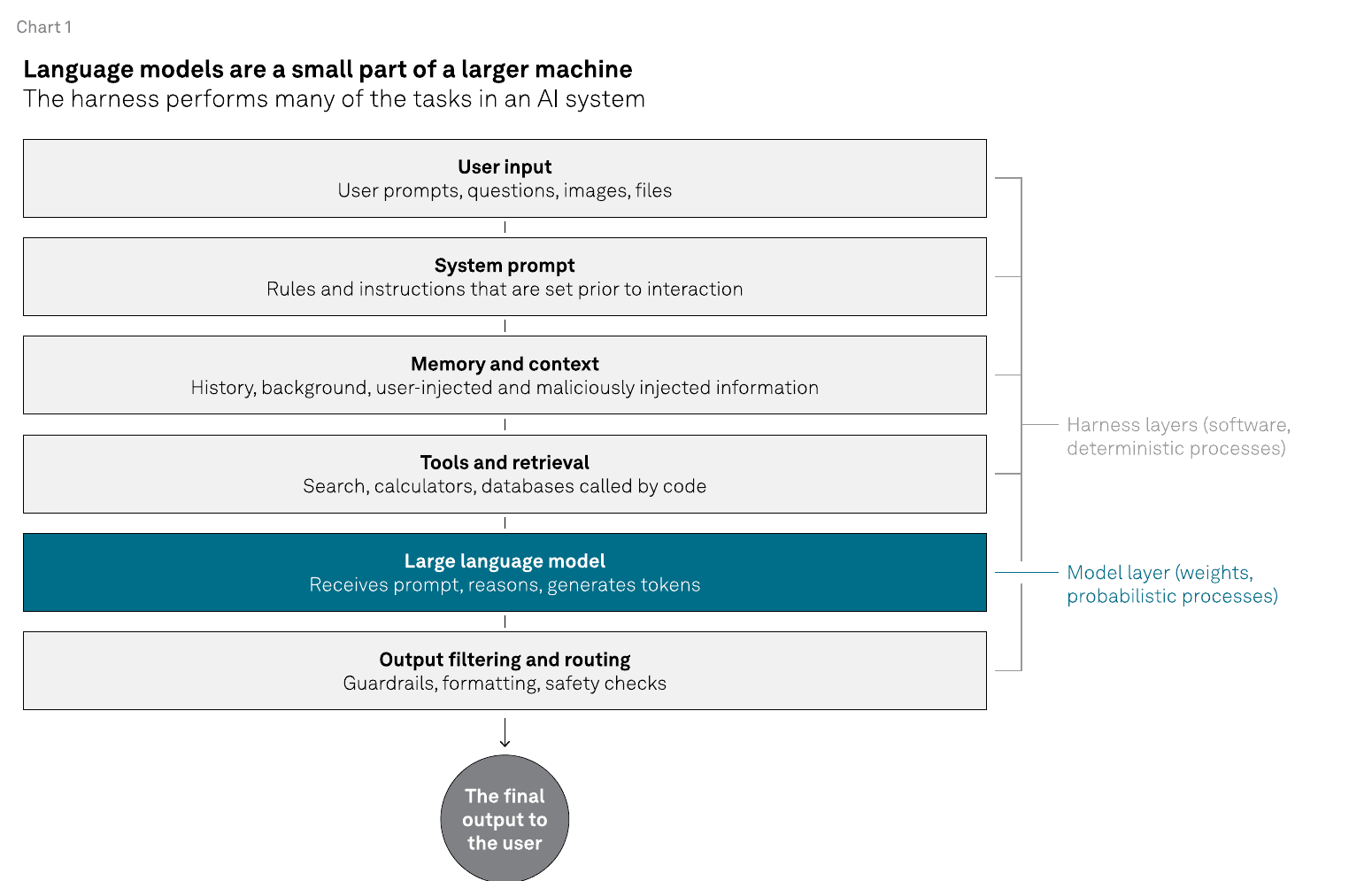
AI Is Reshaping Cyber Risk
Mythos is perhaps best understood as a point on a continuum. AI has been incrementally reshaping the cyberthreat landscape for several years through a set of key, intersecting dynamics.
Attack democratization
Autonomous exploit chaining — combining multiple vulnerabilities to compromise even fully patched systems — has historically required nation-state-level resources and elite specialist teams. AI models capable of performing this autonomously lower that barrier, increasing the repeatability of complex attacks. Anthropic estimates comparable capabilities will reach a broader set of adversarial actors within six to 18 months.
A structurally broken remediation gap
The gap between vulnerability discovery and remediation predates Mythos, but AI-accelerated discovery further undermines the assumption that the two can operate at comparable speeds. NIST data shows mean time to remediation (MTRR) is two to nine times the rate of discovery for medium- to critical-severity vulnerabilities. This highlights that the problem is not the discovery of more weaknesses, but reaction times limited by how quickly patches can be deployed — particularly to infrastructure with operational constraints, uptime obligations, or legacy dependencies.
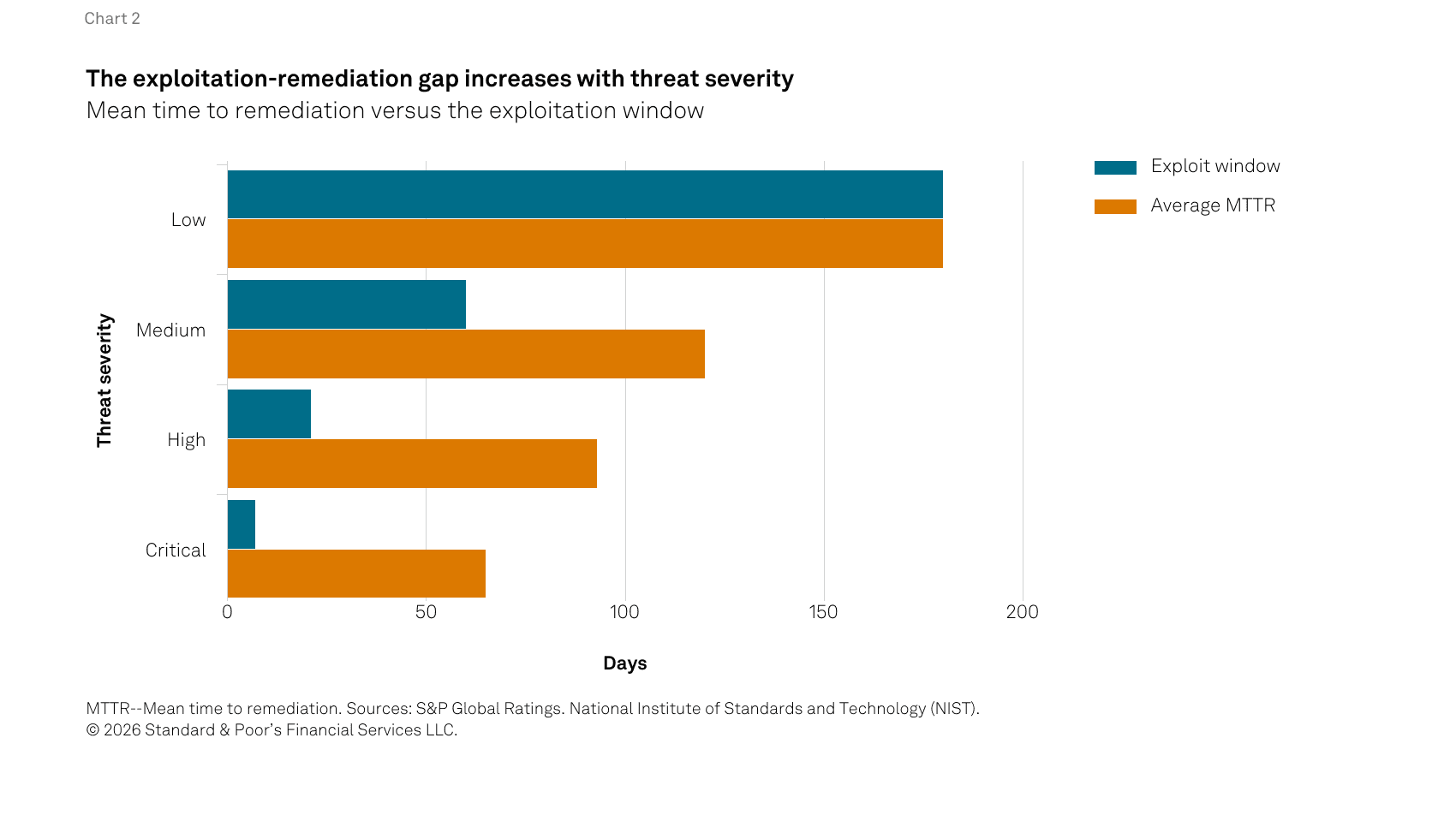
Systemic and supply chain exposure
AI-assisted threats extend the attack surface beyond individual organizations to shared infrastructure — open-source libraries, cloud hypervisors, payment rails, and common cryptographic implementations. A single high-severity finding can trigger credit-relevant consequences well beyond the initially breached entity through third-party dependencies, shared vendors, interbank exposures, and reinsurance chains. This contagion channel is analytically analogous to financial systemic risk modeling.
Structural defensive asymmetry across issuers
AI-accelerated exploitation affects organizations unequally. While larger, well-resourced issuers generally exhibit stronger cyber hygiene, organizational complexity can impede decision-making. More fundamentally, attackers can scale capabilities at marginal cost through automation and reusable tooling, while defense depends on scarce talent and complex processes. Speculative-grade issuers face the greatest exposure asymmetry due to smaller security teams, slower patch cycles, and fewer resources to absorb remediation costs.
How Cyber Risk Becomes Material To Credit Quality
S&P Global Ratings considers cyber risk a factor in governance assessments and, through that lens, an element bearing on creditworthiness. Cyberattacks have generally produced limited rating actions where issuers maintain proactive risk management and preparedness, adequate insurance, and sufficient liquidity and financial headroom under credit metrics. Negative ratings actions typically follow significant operational disruption, slow recovery, or material financial damage.
| Pathway | Description |
|---|---|
| Direct breach costs | Incident response, regulatory fines, litigation, and remediation are the most visible threats to credit quality. AI-facilitated exploit chaining increases both the frequency and severity of these costs. |
| Operational disruption | System downtime directly impairs earnings in sectors with high uptime obligations, such as retail, transport, financial infrastructure, and utilities. Agentic attack chains can generate multi-system outages from a single point of initial access. |
| Counterparty and supply chain contagion | Third-party breaches affecting shared vendors, payment processors, or cloud providers can create indirect credit-relevant exposure for entities with otherwise strong security postures. |
| Rising insurance costs | Cyber insurers are tightening underwriting in response to AI-era threat velocity. Premium increases and emerging AI-related exclusions could impact balance sheet protection. |
| Regulatory pressure | The SEC's 2026 examination priorities elevated cybersecurity and AI to the dominant risk focus. DORA enforcement across EU financial services is creating direct capital and operational consequences for noncompliance. |
| Reputational and market access impact | Major breach events now trigger immediate analyst and investor scrutiny of security governance for investment-grade issuers, with observable effects on risk premiums and cost of capital. |
Governance And Leadership As Differentiating Variables
Research on organizational cyber resilience consistently identifies governance failures as more financially damaging than purely technical ones. AI has not changed what effective cybersecurity looks like; it has changed the speed and scale at which weaknesses are exposed.
- Cybersecurity as a balance sheet resilience factor, rather than a technology cost center. Leaders are rebuilding skilled security teams where they had replaced personnel with AI-based automation to cut costs.
- Structural combination of security teams and data/AI development functions, removing silos that create blind spots around AI model and data-layer risk.
- Recalibration of the CISO role from operational management toward higher-level oversight, connecting cyber posture to regulatory standing, credit profile, and counterparty trust.
- Adoption of zero-trust architecture, which materially limits lateral movement in an exploit chain versus traditional perimeter-based models.
- Formal AI governance frameworks embedded within operational oversight, rather than informal, advisory-only "shadow" governance.
The Benefits Of The Mythos Effect
The fears surrounding Mythos — AI as a tool for autonomous, large-scale vulnerability discovery and exploitation — are already shaping the threat landscape, regardless of any single model. If Mythos's high-profile launch draws attention to that trajectory, it will have been a positive development, whether the model itself constitutes a genuine inflection point or merely an evolution.
Yet the same capabilities that make Mythos a threat to cybersecurity are also deployable defensively. Project Glasswing is built on the premise that AI can be used to identify weaknesses before adversarial actors do. For rated entities, the credit-relevant question is not whether AI will be used against them, but whether their organizational design, governance, and investment priorities enable them to leverage AI to enhance cyber defense at a speed that keeps pace with an accelerating threat landscape.
The views expressed are those of the authors and do not necessarily reflect the opinions of S&P Global.